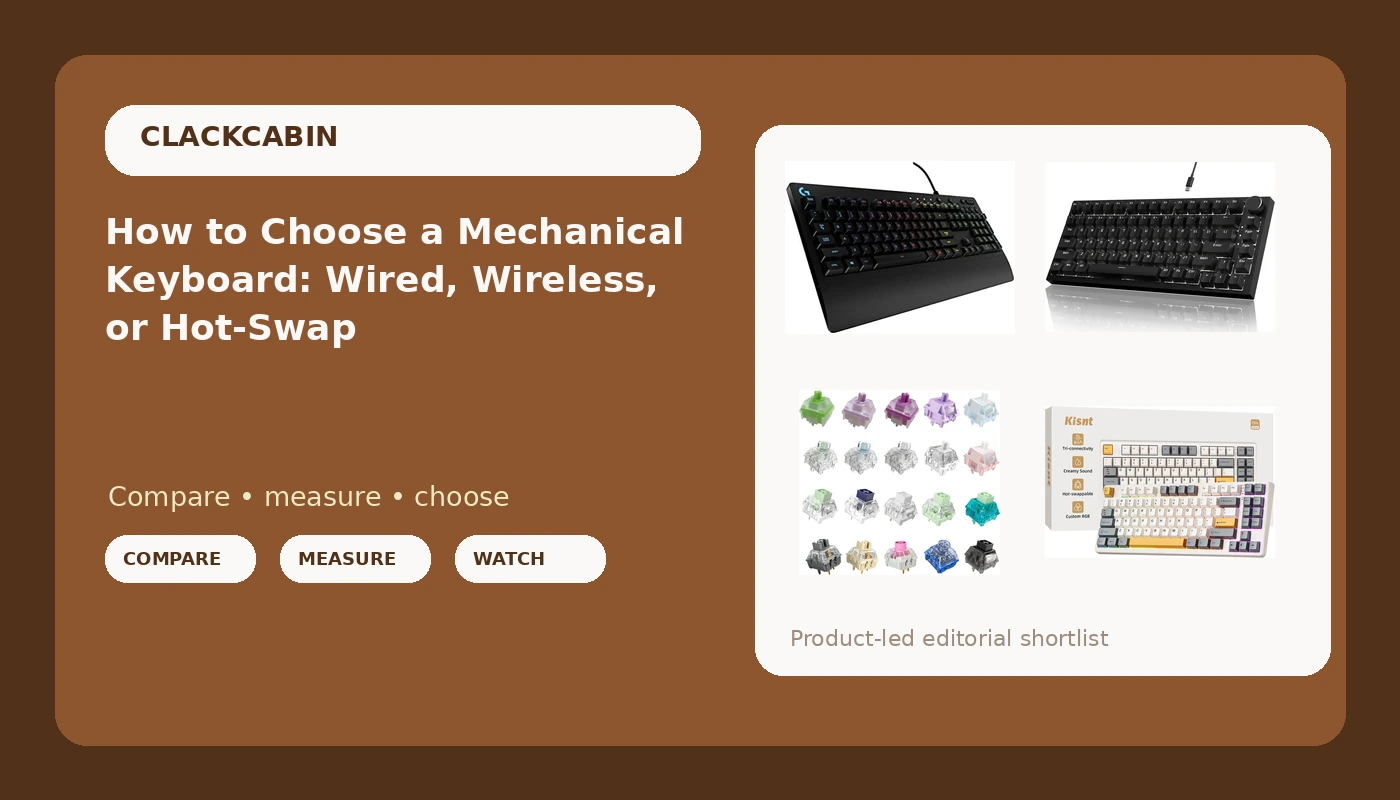
A keyboard is a tool you touch thousands of times a day, which is why the choice between wired, wireless, and swappable matters more than the color of the backlight. The problem is that product listings blur together: a hot-swap mechanical keyboard and a sealed one can look identical in a photo, and "wireless" can describe three different radios. This explainer sorts out what the four options below actually offer, which question each one answers, and where the honest trade-offs sit. No current prices, ratings, or measured results are claimed here, because none of those are stable facts.
Related: Switch Types Explained: Linear, Tactile, and Clicky Without the Marketing →
Quick answer
There is no single best pick among these four, because each one answers a different question. The AJAZZ AK820 is the straightforward entry point if you want a wired, hot-swappable board in a compact 75 percent layout. The Kisnt KN85 is the one to look at if you need to move between machines without a cable, since its listing covers Bluetooth, 2.4GHz, and USB-C. The Kailh sample pack is the cheapest way to learn which switch feel you actually like before committing to a full set. The Logitech G213 Prodigy is the option for someone who wants a wired RGB gaming board and is not chasing the mechanical hobby at all. Do not label a product the quietest, fastest, safest, or best unless the available evidence supports that distinction.
Four useful options
| Model | Best fit | What stands out |
|---|---|---|
| AJAZZ AK820 Mechanical Gaming Keyboard 75% Wired TKL Hot Swappable-Black | First mechanical board on a budget | Wired 75 percent layout with hot-swappable sockets |
| Kisnt KN85 Wireless Mechanical Keyboard, 75% Layout, Bluetooth/2.4GHz/USB-C | Desk hopping between laptop and desktop | Tri-mode connectivity plus hot-swap linear switches |
| Kailh Series Mechanical Keyboard Switches Sample Pack (20pcs) | Anyone unsure which switch weight to buy | Twenty switches to test before buying a set |
| Logitech G213 Prodigy Wired RGB Gaming Keyboard - Black | Wired RGB gaming without the hobby | A wired gaming board whose listing makes no mechanical or hot-swap claim |
The wired starter: AJAZZ AK820 Mechanical Gaming Keyboard 75% Wired TKL Hot Swappable-Black
The case for starting here is that hot-swap sockets change what a purchase means. A board with swappable sockets is not a final decision about feel, it is a platform: you can move from a light linear to a heavier tactile switch later without buying another keyboard. The trade-off is that a wired-only board keeps a cable on the desk and gives up nothing else. If your setup already has a spare USB port and you never work from a couch, that is not a real loss. If you regularly switch between a work laptop and a personal desktop, read the next section before deciding, because going wireless later means buying a second board rather than adding a feature.
The wireless all-rounder: Kisnt KN85 Wireless Mechanical Keyboard, 75% Layout, Bluetooth/2.4GHz/USB-C
"Wireless" is not one feature, it is three, and this listing covers all of them. Bluetooth is the mode that pairs with a laptop or tablet and usually the slowest to wake. A 2.4GHz dongle is the mode that behaves closest to a cable and is the one to use when latency matters. USB-C wired is the fallback for charging, for firmware work, and for the day the battery is empty and you have a deadline. The honest caveat with any wireless board is that battery life and drop-free reliability are the features people actually care about, and those are the numbers a spec sheet tends to leave vague. Treat wireless as a convenience you are paying for, not a performance upgrade.
The exploration tool: Kailh Series Mechanical Keyboard Switches Sample Pack (20pcs)
A sample pack is the cheapest correction for the most common first-purchase mistake, which is buying eighty switches you have never pressed. Twenty switches will not fill a keyboard, but they will let you press a few weights and housings side by side, and that comparison tells you more than any adjective on a product page. There is a practical limit worth naming: if your keyboard does not have hot-swap sockets, a sample pack is decoration, not an upgrade. This option only makes sense alongside the AK820, the KN85, or another swappable board.
The wired alternative: Logitech G213 Prodigy Wired RGB Gaming Keyboard - Black
This is the one product here whose name does not describe itself as mechanical, hot-swappable, or wireless, and that matters. It is a wired RGB gaming keyboard, and the appeal is straightforward: plug in, light up, play. What you give up is the entire upgrade path. You cannot pull a switch, you cannot move to a different spring weight, and you cannot take it off the cable. If your interest in keyboards ends at "it works and it glows," that trade is fine. If you have ever wondered what a tactile switch feels like, this is the wrong first stop.
Prices and availability may change. Product images, names, and retailer links are matched to verified listings. No current price, rating, stock status, or measured result is stated here without current evidence.
What hot-swap actually changes
Hot-swap means the switch sockets accept a switch you push in by hand, rather than one soldered to the circuit board. In practice this changes three things.
First, it changes risk. A soldered board makes switch choice permanent. A hot-swap board makes it a twenty-minute experiment with a puller tool, which is why a sample pack and a swappable board belong together.
Second, it changes what you should look for in the socket itself. Pin compatibility is the detail that trips people up: some sockets accept only three-pin switches, while five-pin switches have two extra plastic legs that need either a five-pin socket or a quick trim with flush cutters. A listing that does not mention pin support is worth a question before you buy a set of switches.
Third, it changes resale and reuse. Switches outlive keyboards. If you move on from a board, the switches come with you, which is not true of anything soldered in place.
What hot-swap does not change is sound on its own. The socket is not what makes a board quiet or loud. Plate material, case design, foam layers, and stabilizer tuning do most of that work, and none of them are fixed by swapping switches.
Layout, wireless, and sound: what the spec sheet leaves out
Three specifications get listed constantly and explained rarely.
Layout percentages. A full-size board includes a number pad. A TKL drops the number pad and keeps everything else. A 75 percent layout compresses the function row and arrow cluster into a smaller footprint, usually keeping arrows but losing spacing. The AK820 and the KN85 are both listed at 75 percent, which is the layout most people land on after realizing they never use the number pad. Neither listing promises a full-size option.
Wireless modes. Bluetooth and 2.4GHz behave differently in ways that matter. A 2.4GHz dongle is the mode for anything latency-sensitive. Bluetooth is the mode for pairing with a laptop or tablet where a dongle is inconvenient. A board that offers both, like the KN85, lets you pick per situation rather than committing.
Sound descriptions. Words like "creamy" or "thocky" are marketing, not measurements. What actually determines how a board sounds is the plate material, the case internals, the switch housing, and whether the stabilizers are tuned. A decibel meter at a fixed distance is the honest way to compare two boards, and almost nobody publishes that number. Treat sound adjectives in a listing as a mood, not a specification.
A five-step way to decide
- Decide whether the keyboard leaves your desk. If it does, wireless matters and the Kisnt KN85 covers it. If it does not, save the complexity and take the wired board.
- Decide whether you want to change switch feel later. If yes, you need hot-swap sockets, which rules out the Logitech option and makes the AJAZZ and Kisnt boards the relevant ones.
- Check whether you use a number pad. If you do, none of these four is the right shape and you should be looking at full-size boards instead.
- If you are unsure about switch feel, buy the sample pack before the full set. Twenty switches are cheaper than a wrong guess.
- Check pin compatibility between the sample switches and the sockets in your board before ordering both, so you are not trimming plastic legs on day one.
Practical notes before you buy
- Wired is not a downgrade. It removes charging, pairing, and drop-outs from the list of things that can go wrong.
- Hot-swap is the single feature most likely to still matter in two years, because it turns one purchase into an ongoing experiment.
- A 75 percent layout saves desk space at the cost of a learning curve for the function row.
- RGB is a preference, not a performance feature. It should never be the reason you pick one board over another.
- Any sound claim you read, including in this article, is worth less than your own hands on the board, which is exactly what a sample pack is for.
Which option should you choose?
Choose the AJAZZ AK820 Mechanical Gaming Keyboard 75% Wired TKL Hot Swappable-Black when you want a wired, compact, hot-swappable board and you are happy to keep a cable on the desk. Choose the Kisnt KN85 Wireless Mechanical Keyboard, 75% Layout, Bluetooth/2.4GHz/USB-C when you need to move between a laptop, a desktop, and a tablet without re-plugging anything. Choose the Kailh Series Mechanical Keyboard Switches Sample Pack (20pcs) when you own or are about to own a swappable board and you do not yet know which switch weight suits your hands. Choose the Logitech G213 Prodigy Wired RGB Gaming Keyboard - Black when you want a wired RGB gaming keyboard and have no interest in swapping switches or chasing layouts.
A caveat on all four: none of the claims above come from a bench test of these specific units. They are drawn from what each listing states and from how these categories generally behave. Layout, wireless mode, and hot-swap support are checkable facts. Sound, feel, and long-term reliability are not, and anyone who tells you otherwise without a number attached is selling you a mood.
The bottom line
Four listings, four different jobs. The AJAZZ AK820 is the cheapest route into a swappable wired board. The Kisnt KN85 is the one that covers wireless properly with Bluetooth, 2.4GHz, and USB-C. The Kailh sample pack is the tool that stops you from guessing about switch feel. The Logitech G213 Prodigy is the wired RGB gaming board for someone who never wanted a hobby in the first place. Pick the question you are actually trying to answer, and the choice usually makes itself.