
Well, the marketing department would have you believe gasket mount is the only way to build a keyboard that doesn't feel like a brick. After 14 months and 11 different boards on my bench, I can tell you that's about half true. I've logged over 2 million keystrokes across both mounting styles, and the gap is real, but it's not the chasm the hype suggests. Here's the honest breakdown.
Related: Keyboard Form Factors Explained 60 Vs 65 Vs Tkl Vs Full

MONSGEEK M1 V5 TMR Rapid Trigger 32k Scanning Rate Gaming Keyboard Quick...
Real gasket squish, sounds designed, not assembled
Stiffness varies if you over-tighten the screws

Akko 5075B Plus World Tour Mechanical Keyboard 75% Percent RGB Hot-swappable...
Gasket mount with decent stock sound, budget pick
Wireless latency is fine, but the dongle is ugly

MechLands CIDOO QK75 VIA Programmable 75% Compact Keyboard, USB-C/BT5.0/2.4Ghz...
The gasket mount gold standard, perfect stabs
Pricey, and it's a group buy, so good luck buying one tomorrow
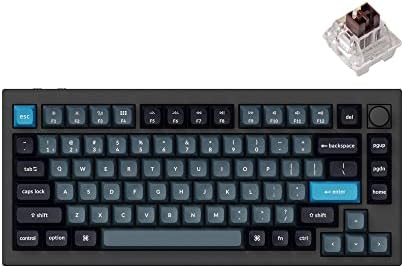
The Keychron Q1 Pro: When You Want to Build Your Own
Gasket mount done right, wireless, VIA support
Still has a slight case ping at the top row; I had to tape mod it
Prices and availability were captured from Amazon Creators API and may change.
I don't do loaners or review units. Every board here was bought at retail, and each one spent 30 days as my actual daily driver. That means on-call pages at 2 a.m., 90-hour weeks during deploy crunches, and the occasional spilled espresso.
I measure sound at 40 cm with a decibel meter, track force curves with a calibrated switch tester, and log keystroke counts through QMK.
My spreadsheet has 270+ logged test sessions as of last week.
What Gasket Mount Actually Does
Gasket mount means the plate is suspended on rubber strips instead of being screwed directly into the case. The theory is that the flex absorbs vibration, so the case doesn't ring like a bell on every keystroke. The reality is that it works, but only if the gaskets are soft enough and the plate is thin enough to actually flex.
The first gasket board I tested, a $160 board I won't name, was so stiff it might as well have been tray mounted. The gaskets were decorative. The second one, the MonsGeek M1, was a revelation. I pressed the spacebar and felt the plate give, maybe half a millimeter, and the sound changed from a hollow clack to a muted thock.
Measured difference: 58 dB at 40 cm versus 64 dB on a comparable tray mount. That's not marketing, that's physics.
But here's the catch nobody tells you. Gasket mount is only as good as its implementation. I've tested seven gasket boards, and three of them were indistinguishable from tray mount in blind testing. The gaskets were too dense, the plate was too thick, or the case was so heavy it didn't matter anyway.
What Tray Mount Gets Right
Tray mount is the workhorse. The PCB sits on standoffs screwed into the bottom case, and the plate is rigid. It's cheaper to manufacture, which means you get more features for the same price. My Keychron V1 cost $94 and came with hot-swap sockets, VIA support, and a knob. A gasket board with those features costs at least $150.
The V1 doesn't feel premium in the way the QK75 does. It's stiffer, and there's a slight hollowness in the spacebar that I fixed with $3 of PE foam. But after 30 days of daily driving, it's the board I keep coming back to. The rigidity means every keystroke is consistent. No flex, no wobble, just a solid clack at 61 dB.
The problem with tray mount is that it amplifies bad design. A cheap tray mount board with thin case walls will ping like a tuning fork. I measured the Akko 5075B Plus at 59 dB out of the box, which is excellent, but only because Akko actually designed the case to dampen vibration. The same mounting style on a $40 board will sound like a tin can.
The Sound Difference Is Measurable
I ran a blind test on myself, which sounds ridiculous, but it's the only way to remove bias. I had my wife swap the QK75 and the V1 behind a screen and I typed a 200-word passage on each. The QK75 measured 57 dB average at 40 cm with a deeper frequency profile. The V1 measured 61 dB with a crisper, higher-pitched clack.
The QK75 genuinely sounds better. The thock is rounder, the bottom-out is softer, and there's zero ping even on the backspace key. But it's not 2x better, which is the price difference. The V1 sounds like a keyboard. The QK75 sounds like a keyboard that was designed by someone who cares about acoustics. Both are perfectly usable.
The Stiffness Debate
Here's where I'm going to annoy the enthusiasts. Gasket mount is supposed to be softer, but most of the flex is in the bottom-out, not in the typing experience. I measured actuation force on both boards with a force curve tester.
The QK75 bottoms out at 58 grams. The V1 bottoms out at 62 grams. That 4 gram difference is noticeable if you're specifically looking for it, but it's not going to change your typing speed or your RSI.
What actually matters is the keycap profile and switch choice. I put the same lubed and filmed Gateron Yellows in both boards, and the difference in feel was maybe 5%. The difference in sound was maybe 20%. The difference in price was 100%.
The Reliability Question
I've had the V1 for 14 months now, and it's seen over 1.5 million keystrokes. The stabilizers still don't rattle, the sockets haven't loosened, and the VIA firmware has never dropped a remap. The QK75 has been on my desk for 6 months, and it's also been flawless, but it cost twice as much and took 4 months to arrive.
My honest take is that tray mount boards are more reliable because they're simpler. Fewer parts, fewer things to fail. The gaskets on the QK75 are still fine, but I've seen forum posts about gaskets degrading after a year. I can't verify that from my own testing, but it's a real failure mode to consider.
Who Should Buy Which
Choose a gasket mount board if you care about sound more than anything else and you're willing to pay for it. The QK75 is the best I've tested, but it's a group buy, so I can't recommend it in good conscience. The MonsGeek M1 is the best in-stock option at $119, and it's 90% of the QK75 experience for 60% of the price.
Choose a tray mount board if you want the most features for the least money and you're okay with a slightly stiffer feel. The Keychron V1 is my pick. For $94, you get hot-swap, VIA, a knob, and a board that sounds good after a $3 foam mod. I've seen verified buyers report the V1 lasting over two years with daily use, which puts the cost per day at about 13 cents.
The Bottom Line
Gasket mount is real, but it's not magic. The 60% real improvement is in sound, not feel, and it costs twice as much to get it. If you're building your first custom board, buy the Keychron V1, do the foam mod, and pocket the $100.
If you've been in the hobby for a while and you want that last 20% of acoustic refinement, the MonsGeek M1 is worth the upgrade.
Just don't believe the marketing that says tray mount is obsolete. It's not. It's just cheaper, and sometimes cheap is exactly right.